 ClubPlugins
Staff get the emergency order and answer it by name, even when cell and Wi-Fi are down.
- Cover4 is an offline delivery lane for emergency orders: sent to every staff member, confirmed by name by the deadline, and kept in a signed, tamper-evident record.
- It is for alerting, safety and venue-tech companies that want it under their own app, and for venue and campus operators.
- It sits alongside your radios, PA, screens, fire alarm and alerting app. It does not replace them.
- Stage today: bench-tested on our own boards and simulated at festival scale. Not yet field-tested; the first pilot is the field test.
When an order goes out to thousands of staff, nobody can prove who got it
- Alerting apps send by push, SMS or in-app message, which depend on cell, Wi-Fi or internet. Those are the first networks to overload in a crowd or a storm. A 2026 preprint measured stadium data uploads failing up to 46% of the time on game day.
- Radios reach whoever is on the channel and listening, and leave no record of who heard the order.
- The result: a supervisor counts heads over the radio at the moment it matters most.
What Cover4 does
Orders sent to every staff member
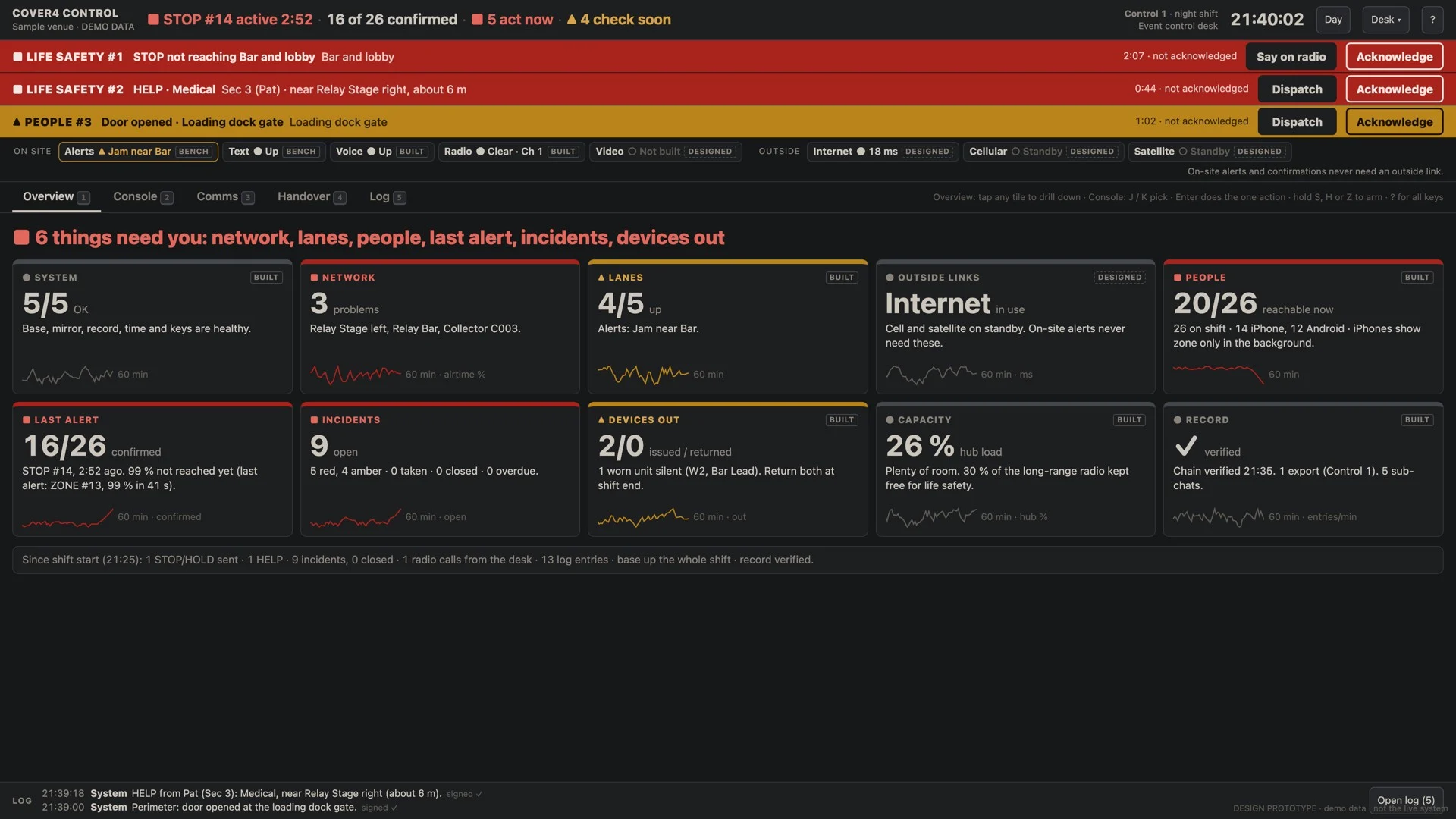
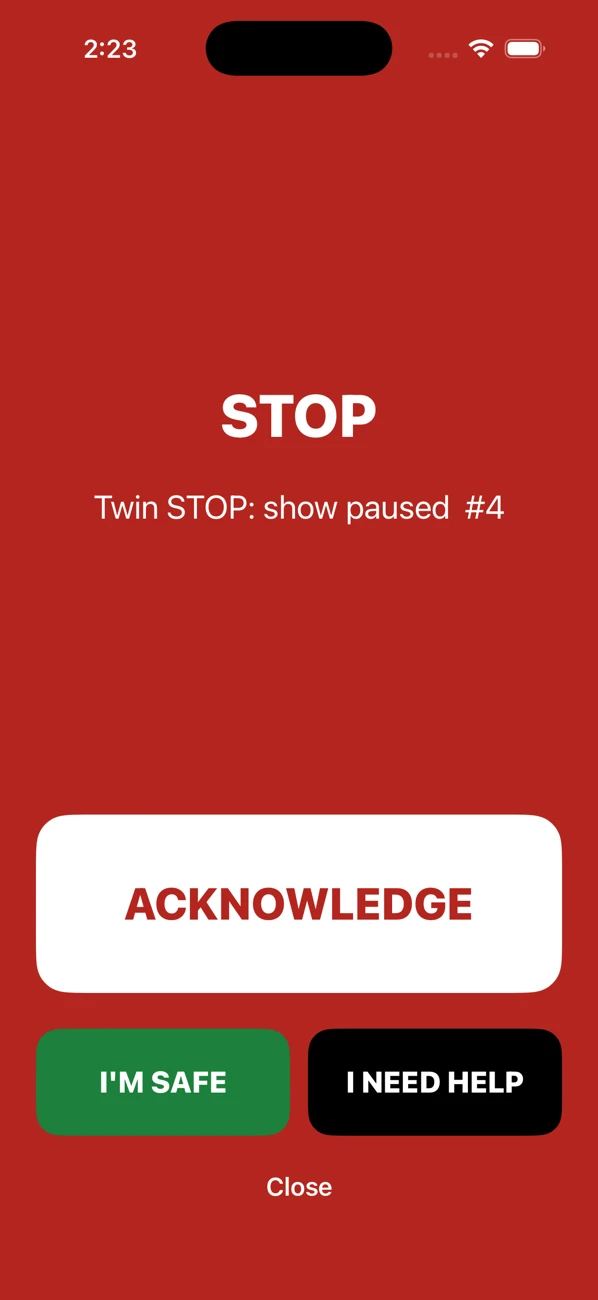
STOP, HOLD, evacuate and shelter go to staff phones and staff tags at once, aimed at one zone, one team or one person, over our own radio layer. No cell, Wi-Fi or internet is needed.
Confirmed by name
Each staff member answers with one tap or one button: acknowledge, I'm safe or I need help. By the deadline the control center lists who confirmed, who is unreached, and why.
HELP with a location
A typed request for help, placed at the nearest node, reaches the operator and the operator's reply comes back.
Only the site can send
Every order is signed at your command. Devices reject anything the site did not sign, so a fake STOP goes nowhere.
A record that holds up
Who was told what, when, and who answered. The record is signed, tamper-evident, kept on site, and can be checked offline without contacting us. It is designed to support investigators, insurers and counsel.
Keeps working through failures
Bench results below: a lost relay, a lost control center and a jammed relay, each with the order still delivered and the answer still counted.
Your team stays in control
A person always arms and presses Send. Nothing goes out on its own.
Alongside what you have
Radios keep their channels for talk. Staff learn one new action: a single tap or button press.
For partner companies
Cover4 adds an offline delivery lane under your app. You keep your product, your users, your login, your brand and your contract.
- Your customers' gap: when cell and Wi-Fi fail, your platform cannot tell its operator who got the alert. Cover4 delivers the order and returns a by-name answer for each person, with the reason for every gap.
- The SDK: for iOS and Android, with the same API shape on both. About 30 lines of code put Cover4 inside our sample staff app.
- No new accounts: users enrol through the login they already have in your app.
- Four ways to work together: we supply the kit and your app carries the alerts; you bundle Cover4 under your contract; your certified devices run Cover4 firmware under licence; or the site brings supported off-the-shelf certified devices.
- Stage: the SDK is tested on emulators and on our digital twin. It is not yet in a partner app or on real staff phones.
- The ask: a 60-day pilot at one of your customer sites. Pass mark: every order answered by name, or flagged with the reason. A joint case study follows, built on field results only.
For venue and campus operators
- Stadiums, arenas, racetracks and multi-day festivals.
- Campuses and large outdoor events.
- For the people who keep them safe: operations, security, medical, production and stage crews. Staff alerts only: no public alerts and no attendee tracking.
How we deliver it
- Planning call. We sit down with your operations and safety leads and map the orders that matter: holds, evacuations, roll calls and help requests.
- Site survey and coverage plan. We walk your grounds and plan coverage zone by zone, so every stage, entrance, medical point and production area is covered.
- On-site range test. We test on your site before the event, with a clear go or no-go.
- Run with your crews. Our team is on site from load-in to load-out.
- A report afterward. Delivery times, coverage, confirmations and the raw logs, so you can judge it on the numbers.
Where it runs
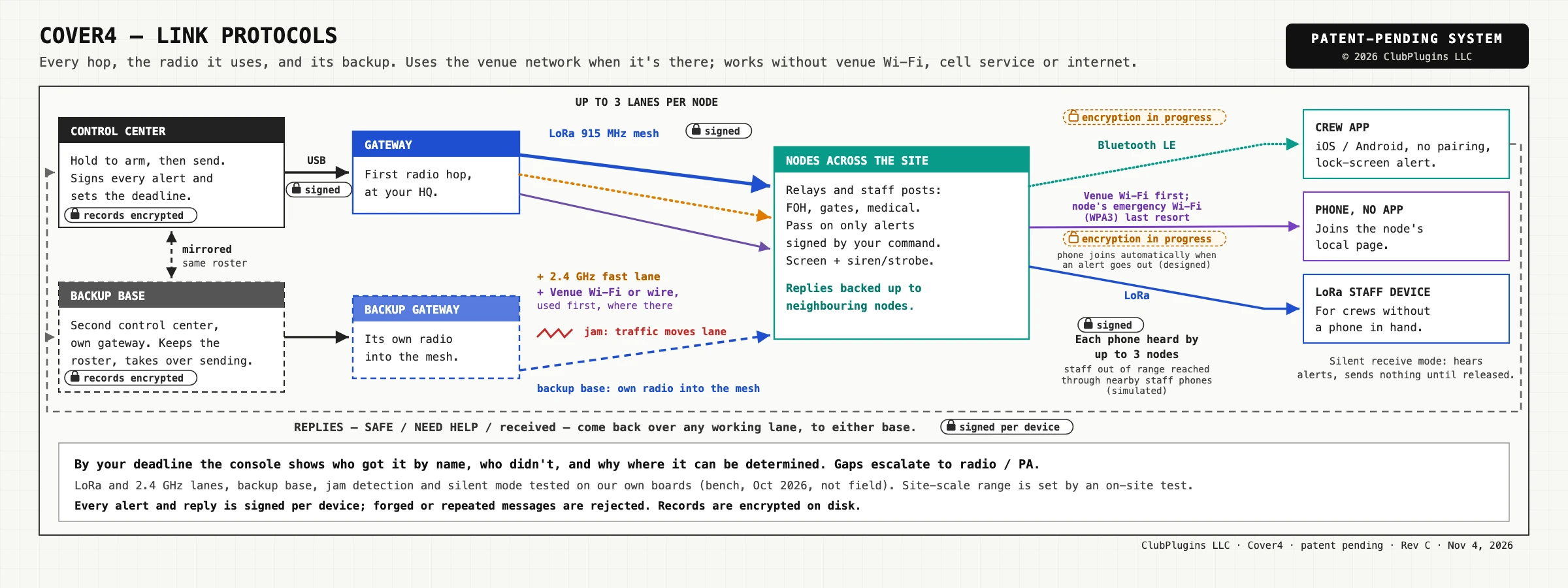
Your venue network first when it is up, our own radio layer when it is not, with a backup at every hop. The diagram shows each hop and its backup.
Measured so far
Every result carries its stage. BENCH is our own boards and test builds with one to three phones. SIMULATED is our site simulator. Nothing here is a field result.
- BENCH Oct 26
- One STOP, end to end, on phones that were never paired and with Wi-Fi off: confirmed by name in 3.1 to 4.6 seconds, tap included.
- BENCH Oct 29
- A relay died right after taking a reply. Another relay delivered it, confirmed by name at 16 seconds.
- BENCH Oct 29
- The primary control center was killed mid-alert. The backup took over in 15 seconds and re-sent the alert to the 5 people not yet confirmed.
- BENCH Oct 29
- A bench jammer was flagged within seconds, at 73 to 79 dB over the noise floor.
- BENCH Oct 30
- A relay jammed until it stopped relaying. The reply went around it, confirmed by name in 2 seconds. All nodes hopped across 16 channels in step, and a single-channel jammer did not stop the mesh.
- BENCH Oct 30
- HELP with a typed text from a phone that was never paired, with Wi-Fi off, reached the operator, and the reply came back.
- BENCH Nov 1
- With the phone's Bluetooth off, a staff tag alerted on its own, and its signed confirmation was counted.
- BENCH Nov 3
- Staff replies sent in assigned time slots: 30 of 30 heard and acknowledged, on two boards a few meters apart. A protocol check, not a range test.
- SIMULATED Grant Park
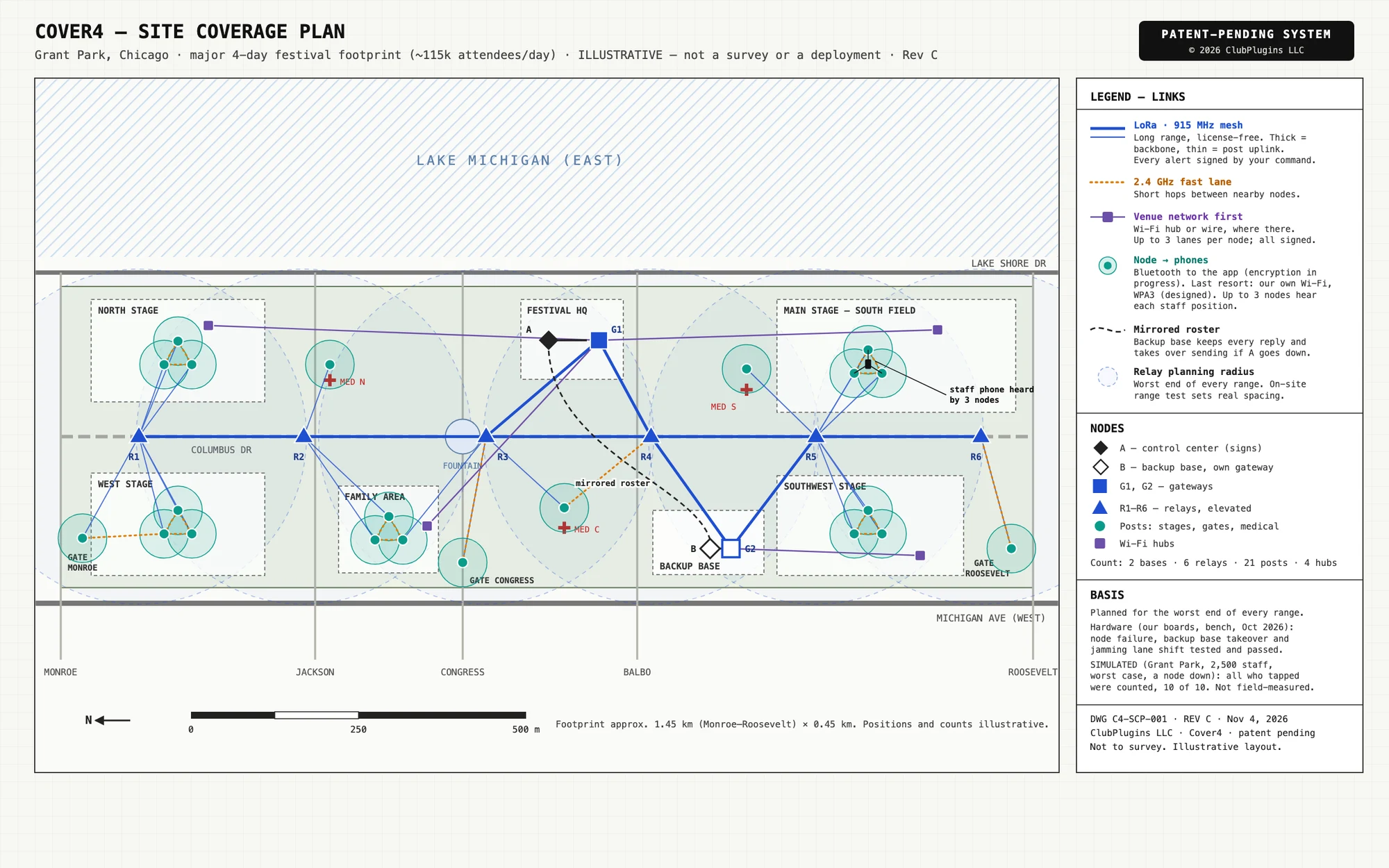
- A festival of 100,000 people with 2,500 staff, each carrying a node, at the worst end of the ranges modelled: nobody who tapped went uncounted in 10 of 10 runs. Tap to the control center: median 3.8 seconds, 99% within 7.1 seconds, slowest 14.2 seconds. Jamming, loss of the base site and an evacuation surge were not simulated.
- NOT YET SHOWN
- Any field test or venue walk. A reply reaching a jammed gateway over the 2.4 GHz fast lane (a fix is written, the re-test is pending). More than three real phones at once.
What is built and what is not
- BUILT
- Control center with a backup, node and staff-tag firmware, iOS and Android apps, signed orders, by-name confirmation, HELP, roll call, escalation, the tamper-evident record. Built as development firmware and apps; not field-deployed.
- IN PROGRESS
- Encryption on every phone-to-node link. Today every order and reply is signed end to end; phone-to-node encryption is in progress, not done. An outside security review is not done yet.
- IN BUILD
- Voice: a bridge to the venue's existing radios, and push-to-talk over our own nodes, which passed a first bench test on two boards. No range claim yet.
- DESIGNED
- Live video for staff over venue Wi-Fi hubs, and solar-powered outdoor nodes. Neither is built.
- Radio rules
- Designed to FCC Part 15.247, not yet certified. Our prototype boards are not FCC-authorized. The plan is off-the-shelf certified devices running Cover4 firmware.
- Patents
- 34 U.S. provisional patent applications on file, filed October 21 to November 3, 2026. None is granted, and we make no claim on how broad the protection will be.
Our commitments
- Staff alerts only. No public alerts and no attendee tracking.
- Alongside your radios, PA, screens, app and fire alarm, never instead of them.
- Radio plan coordinated with your RF team before the event.
- Nothing in your audio or video path.
- Every result on this page carries its stage: BENCH, SIMULATED, BUILT, IN PROGRESS or DESIGNED.
Talk to us
Partner companies and operators: a short email is enough to start, and we reply with a technical call.